


Hendrik Bicknäse


_edited.jpg)

Hendrik Bicknäse
Writer . Critic . Curator
Hendrik Bicknäse, born on March 10, 1947, in Nienburg/Weser, is a renowned German author, journalist, and art educator. His works span a variety of genres and themes, offering readers a profound and captivating reading experience. more
-Photoroom.png)
Awarded the November Prize of the Standing Committee for Cultural Days in Berlin


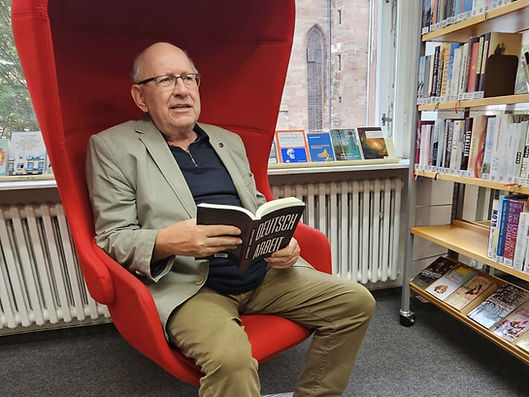
DEUTSCHARBEIT
The title of the autofictional novel is derived from a school German essay on the topic of a possible reunification of West and East Germany as a concrete utopia during the Cold War.
"My rebellious heart became political early on. After the
The bankruptcy of the Nazi dictatorship, of morality and of utopias existed in The Federal Republic of Germany initially reverted to stable role patterns. Adenauer's And Erhard's "No experiments" was paramount. I invite the readers one, with me into the time of German-German division between 1945 and to immerse oneself in 1968. An era of optimism and new beginnings, of trying things out, of discussing with great enthusiasm for new things Experiences in a very narrow world, which we are thus wanted to prevent."
(Excerpt from the afterword)
DEUTSCHARBEIT - Trilogy
Two new novels are in the works::
DEUTSCHARBEIT
Band 2: Experiementelle Zeit
(Roman)
Band 3: Feind ist, wer anders denkt
(Roman)
„Hendrik Bicknäse, himself affected, someone who can only preserve the optimism of the Enlightenment, of linguistic enlightenment, because his desire constantly pushes for language, but impatiently pushes language aside when it wants to keep dreams trapped in beautiful images:
Is it perhaps because my dream is an attack
an attackon the logic of reality
on separation, distinction, and isolation?
My dream's power could
decay the hard core of the expropriators!
I protest against the absolutism
of discursive logic.
But I have the desire
to logically substantiate my protest
o prove, to explain, to clarify.
My desire contradicts me.
My language prevents my desires."
Bernhard Gleim, 28.10.1977, 2nd program, Radio Bremen about a literary weekend with Göttingen writers in Bremen, which took place on 21 and 22 October 1977: "Göttinger Literaten in Bremen" or "niedersachsen literarisch" (p. 64)

Lesung

November 27, 2025
A confrontation with society and the justice system, as well as a gripping family history. Göttingen-based author Hendrik Bicknäse writes about the post-war years up to 1968 in his autofictional novel. Felix Heipke spoke with him.
Interview


November 27, 2025
A confrontation with society and the justice system, as well as a gripping family history. Göttingen-based author Hendrik Bicknäse writes about the post-war years up to 1968 in his autofictional novel. Felix Heipke spoke with him.
Reviews
about " Deutscharbeit "
"Deutscharbeit" has been well received - a true counterpart to Siegfried Lenz's "Deutschstunde." Congratulations! You truly have the talent for powerful writing and you're putting in a tremendous effort. Your writing style has a captivating pull and quickly draws readers in.
On October 3, 2025, we will celebrate 35 years of German unity – a day on which our brothers and sisters were reunited, but also a moment that reveals divisions in our society. That's why we spoke with Hendrik Bicknäse, a contemporary witness to the division and reunification of Germany, whose book "Deutscharbeit – Mein Leben als Sohn" (German Work – My Life as a Son) reflects on personal and societal ruptures. As a writer, journalist, and art mediator, Bicknäse, born in 1947 in Nienburg/Weser, had a unique perspective on the post-war period, the GDR border, and Ostpolitik (Eastern Policy). His experiences – from his pre-trial detention in 1966 for contacting someone in the East to co-founding the Society for Cultural Exchange in 1985 – make him an authentic voice on the challenges of unity. His book has historical depth and addresses current issues of freedom of expression and cultural identity. His work in the anti-authoritarian movement of the 1960s and 70s, his role in the Frankfurt Book Fair (a counter-movement) of 1977/78, and his commitment to Art Without Borders reflect a lifelong dedication to dialogue and international understanding. His critical, nuanced approach encourages reflection on democracy and social cohesion.
Reader review
about "Deutscharbeit"
The descriptions of the happy time without work and his resistance to external control in this novel are to be understood as precursors to future ways of working in the same sense as Georg Büchner's drama Danton: "Our life is murder by work; we hang on the noose for sixty years and twitch, but we will cut ourselves free!" In the current view of the future distribution of work and leisure, the author's pleasure-oriented vision in this GERMAN WORK appears very contemporary.